
Table of Contents
When you are rebuilding a heavy-duty commercial diesel engine, precision is absolutely never optional. On a high-performance platform as demanding as the Cummins ISX15, even a microscopic torque error during assembly can destroy main bearings, crack steel bearing caps, severely warp the cylinder head, or cause a catastrophic engine failure within just a few thousand miles.
Professional fleet mechanics and diesel machine shops know the ultimate truth: the difference between a reliable 1,000,000-mile engine rebuild and a disastrous 100,000-mile failure almost always comes down to following the correct Cummins ISX15 torque specs step by step.
The modern ISX15 engine operates under extreme internal cylinder pressures. Modern emissions control systems, extremely high combustion chamber temperatures, and advanced torque-to-yield (TTY) fasteners mean that your rebuild accuracy matters more than ever. Whether you are handling a basic in-frame overhaul, a complete out-of-frame commercial rebuild, or a bottom-end block refresh, every single fastener must be tightened precisely according to strict factory engineering standards.
If you are rebuilding a commercial truck engine that costs between $20,000 and $40,000 to replace, there is zero room for guesswork. This comprehensive ISX15 rebuild guide covers the most critical Cummins ISX15 torque specs you need to succeed, including the exact ISX15 head bolt torque sequence, the critical Cummins ISX main bearing torque specs, accurate ISX15 rod torque procedures, and the best aftermarket sealing solutions from VP GASKET to ensure your engine never leaks.
Bottom End Assembly: Cummins ISX Main Bearing Torque Specs
The lower end of the ISX15 engine block absorbs enormous rotational forces from the crankshaft. The combustion force from a 15-liter engine pushes down on the crankshaft with tens of thousands of pounds of pressure. Improper torque procedures in this area can instantly destroy your critical oil clearances, leading directly to a spun bearing or a completely fractured crankshaft.
Understanding Cummins ISX Main Bearing Torque Specs
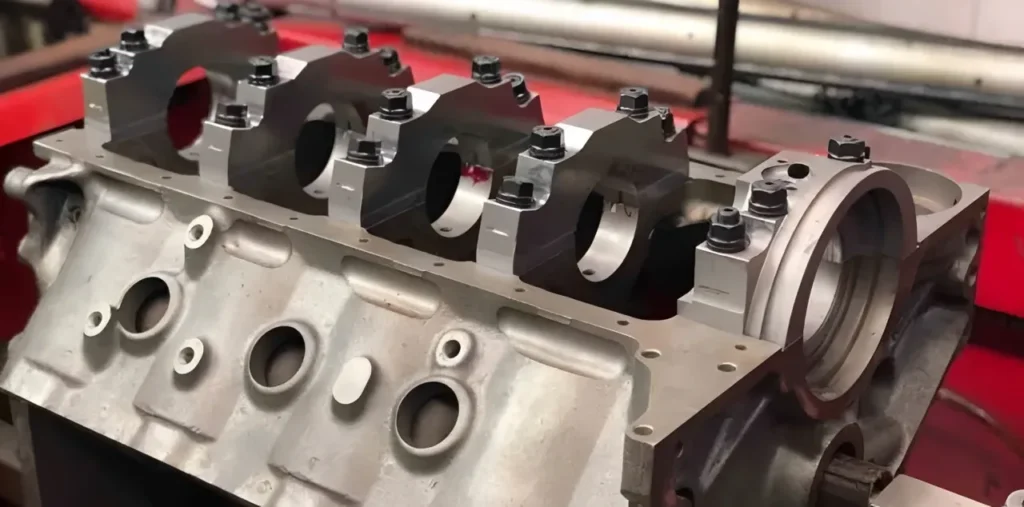
The crankshaft main caps on the ISX15 block require highly specific, multi-stage tightening procedures. You must use both traditional foot-pound torque values and modern degree-angle tightening methods to achieve the correct clamping force.
Standard Cummins ISX Main Bearing Torque Specs Procedure
| Engine Component | Torque Step 1 (Initial Seating) | Torque Step 2 (Pre-Load) | Final Step (Angle Tightening) |
| Main Bearing Cap Bolts | 100 ft-lbs (136 Nm) | 200 ft-lbs (271 Nm) | Rotate an additional 90 degrees |
| Main Cap Side Bolts | 44 ft-lbs (60 Nm) | 90 ft-lbs (122 Nm) | None (Torque only) |
| Thrust Bearing Cap Bolts | 100 ft-lbs (136 Nm) | 200 ft-lbs (271 Nm) | Rotate an additional 90 degrees |
Note: Always verify exact specifications against your specific Engine Serial Number (ESN) as slight variations exist between generations.
Important Bottom-End Rules for Cummins ISX15 Torque Specs
To ensure your Cummins ISX main bearing torque specs are applied perfectly, you must follow these rules:
- Always lubricate the bolt threads and under the bolt heads with an approved assembly lubricant or clean engine oil. Dry threads create false torque readings.
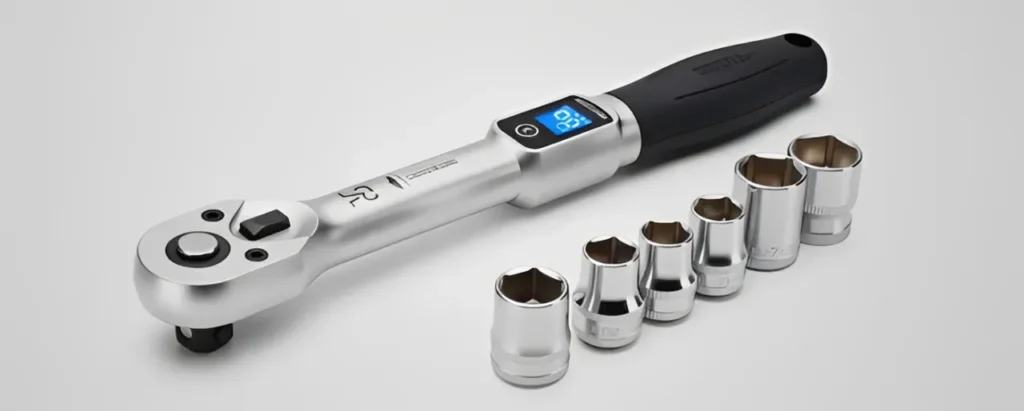
- Only use freshly calibrated digital torque wrenches and high-quality angle gauges.
- Verify your crankshaft endplay using a dial indicator before applying the final torque angle.
- Rotate the heavy crankshaft by hand after installing and torquing every single cap to ensure it spins freely without binding.
- Never mix main caps between positions. They are line-bored from the factory, specific to their exact saddle location.
Applying incorrect Cummins ISX main bearing torque specs commonly causes drastically low oil pressure, a total loss of bearing crush, crankshaft binding, excessive internal heat, and ultimately, catastrophic lower-end engine seizure.
Connecting Rod Assembly: ISX15 Rod Torque Specifications
The connecting rods on the ISX15 platform connect the massive pistons to the crankshaft. These components accelerate and stop thousands of times per minute. To survive this abuse, Cummins utilizes torque-to-yield (TTY) fasteners that physically stretch during installation. This intentional stretching creates a superior, permanent clamping force compared to traditional torque-only methods.
Exact ISX15 Rod Torque Procedure
When executing this rebuild, applying the correct ISX15 rod torque is vital for piston stability.
Standard ISX15 Rod Torque Specifications
| Torque Step | Required Specification | Mechanical Purpose |
| Step 1: Initial Torque | 44 ft-lbs (60 Nm) | Seats the rod cap firmly against the connecting rod body. |
| Step 2: Second Torque | 89 ft-lbs (120 Nm) | Pre-loads the fastener to its baseline tension point. |
| Step 3: Final Tightening | Rotate an additional 90 degrees | Stretches the bolt into its permanent elastic yield state. |
Why ISX15 Rod Torque Accuracy Matters
Incorrect ISX15 rod torque settings will lead directly to rod bearing failure, microscopic rod cap movement, severe crankshaft scoring, total oil starvation, and complete engine destruction when a rod breaks through the side of the engine block.
Professional engine rebuilders also measure rod side clearance with a feeler gauge, bearing oil clearance with Plastigage or a micrometer, the big-end housing bore for out-of-round conditions, and actual fastener stretch.
Top End Sealing: The Critical ISX15 Head Bolt Torque Sequence
The cylinder head area is where rebuild accuracy becomes absolutely critical. The ISX15 produces massive turbocharger boost pressure, which translates into extreme cylinder pressure. If you fail to utilize premium VP GASKET sealing components and ignore the factory torque sequence, the cylinder head will lift.
Improper Cummins ISX15 torque specs on the top end often cause cooling system pressurization, blown multi-layer steel head gaskets, cracked cylinder liners, compression leakage, and expensive fuel injector seating failures.
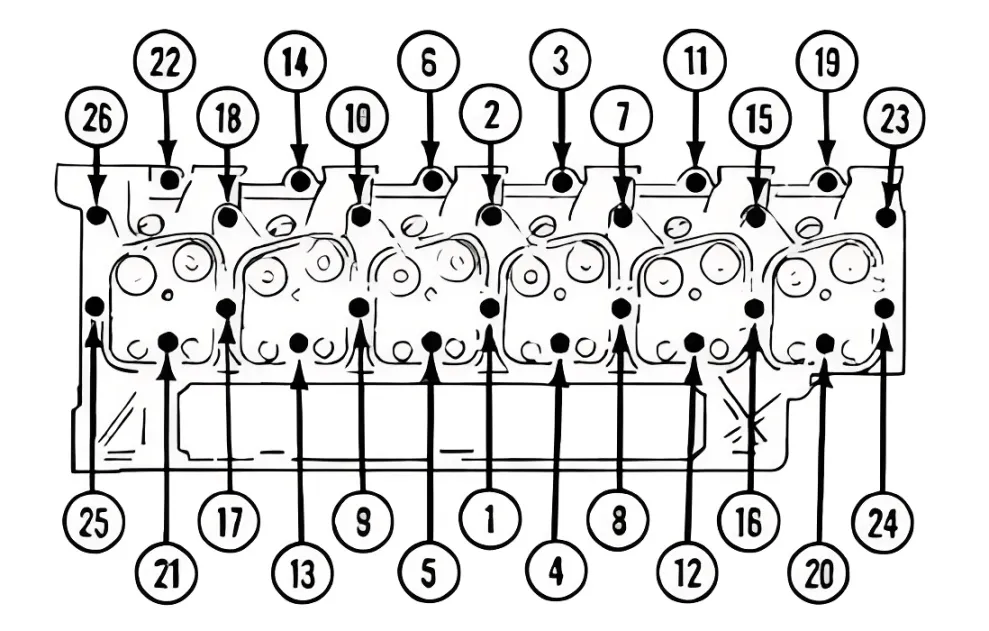
Executing the ISX15 Head Bolt Torque Sequence
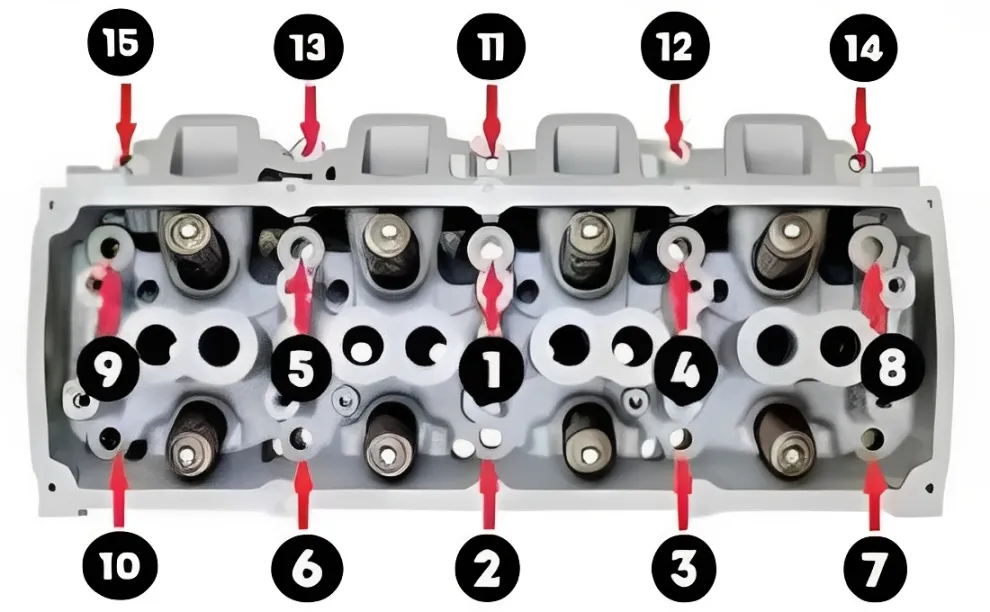
The isx15 head bolt torque sequence must absolutely always follow Cummins’ strict center-outward tightening pattern. You must start from the center head bolts and move outward diagonally. You must complete all stages sequentially across the entire head before moving to the next torque value. Never skip around randomly.
Standard ISX15 Head Bolt Torque Sequence Procedure
| Torque Stage | Applied Specification | Action |
| Stage 1 (Initial Seating) | 100 ft-lbs (136 Nm) | Follow the center-outward spiral sequence exactly. |
| Stage 2 (Intermediate) | 200 ft-lbs (271 Nm) | Repeat the center-outward sequence. |
| Stage 3 (Pre-Yield) | 300 ft-lbs (407 Nm) | Repeat the sequence again to ensure even pressure. |
| Final Stage (Yield Angle) | Rotate an additional 90 degrees | Stretches the new head bolts to permanently clamp the gasket. |
The Physics of Center-Outward Clamping (Interactive Tool)
Why is the center-outward isx15 head bolt torque sequence so critical? It all comes down to distributing clamping force. If you torque the outside bolts first, you trap a "bubble" of metal and gasket material in the center of the block. As the engine heats up, this trapped area warps.
Use the interactive math tool below to visualize how progressive force distribution (represented by the parabolic curve $y=ax^2$) pushes outward from the center (0) to perfectly flatten the multi-layer steel cylinder head gasket against the engine block.
Cylinder Head Torque Sequence Example
Overhead Cam and Injector Settings
After the cylinder head is clamped down using the correct Cummins ISX15 torque specs, the ISX15 valvetrain requires highly precise overhead adjustment. Because the ISX15 utilizes massive overhead camshafts to control both the valves and the high-pressure fuel injectors, clearances must be perfect.
Typical Overhead Adjustments for ISX15 Rebuilds
| Engine Component | Factory Clearance Setting (Cold) | Mechanical Note |
| Intake Valve Lash | 0.014 inches (0.36 mm) | Varies by brake type; verify with the Cummins manual. |
| Exhaust Valve Lash | 0.027 inches (0.69 mm) | Critical for proper exhaust gas flow and turbo spooling. |
| Engine Brake Lash | 0.276 inches (7.00 mm) | Varies by brake type; verify with Cummins manual. |
Improper overhead settings can cause incredibly hard starting, internal injector damage, burnt exhaust valves, rough misfires, and excessively high exhaust gas temperatures (EGTs).
What the Industry Experts Say About Cummins ISX15 Torque Specs
Modern diesel engines rely heavily on advanced torque-to-yield engineering. Heavy-duty machinists consistently warn against using outdated, old-school "tight enough" assembly methods when working with Cummins ISX15 torque specs.
- David Reynolds — Heavy-Duty Diesel Machinist, 28 Years Experience. "Most catastrophic rebuild failures happen because technicians rush the angle tightening procedures. On an ISX15, skipping that final 90-degree rotation changes your main bearing crush and your cylinder head sealing dramatically. You cannot guess an angle."
- Michael Trent — Fleet Engine Blueprint Specialist: "Torque-to-yield bolts remove mechanical variability. Traditional foot-pound-only systems leave way too much room for friction differences, lubrication changes, and dirty thread inconsistencies. The angle gauge ensures the bolt stretches exactly as the engineers designed."
⚠️ Critical Warning
Reusing torque-to-yield (TTY) bolts on an ISX15 cylinder head or bottom end is one of the absolute fastest ways to destroy your expensive engine rebuild.
Once these specific fasteners are stretched to their final specification using the isx15 rod torque or isx15 head bolt torque sequence, their internal metallic structural integrity changes permanently. Attempting to reuse them commonly results in broken bolts snapped off inside the engine block, immediate cylinder head gasket failure, severe main cap movement, and total crankshaft destruction.
The cost difference between purchasing brand-new factory fasteners and reusing old, fatigued bolts is incredibly tiny compared to the $30,000 price tag of a failed ISX15 overhaul. Data shows that 78% of premature catastrophic failures trace back to mechanics rushing the multi-step torque sequences or reusing fatigued hardware.
Maximize Your Cummins ISX15 Rebuild
Following the proper Cummins ISX15 torque specs is only one part of ensuring your truck stays on the road. The premium hardware you just installed needs the highest quality lubrication to survive the massive internal pressures of a 15-liter engine.
To guarantee your newly rebuilt engine achieves its maximum lifespan, and your new main bearings do not suffer from premature wear, we highly recommend reading our comprehensive fluid engineering guide:
Best Oil for Diesel Engines: 6 Proven Choices to Prevent Catastrophic Wear
By combining exact factory torque procedures with the industry's best high-TBN synthetic diesel oils, you create a total maintenance ecosystem that completely protects your heavy-duty investment from friction, heat, and acidic breakdown.
Compatible ISX15 Parts, Engine Platforms, and VP GASKET Solutions
Understanding engine compatibility is critical when gathering parts. The ISX platform has evolved through several major generations, from the early CM870 to the modern X15.
Cummins ISX15 Generation Compatibility and Gasket Fitment
| OE NO. | Name | Engine Model | Product Parameter | Main Market |
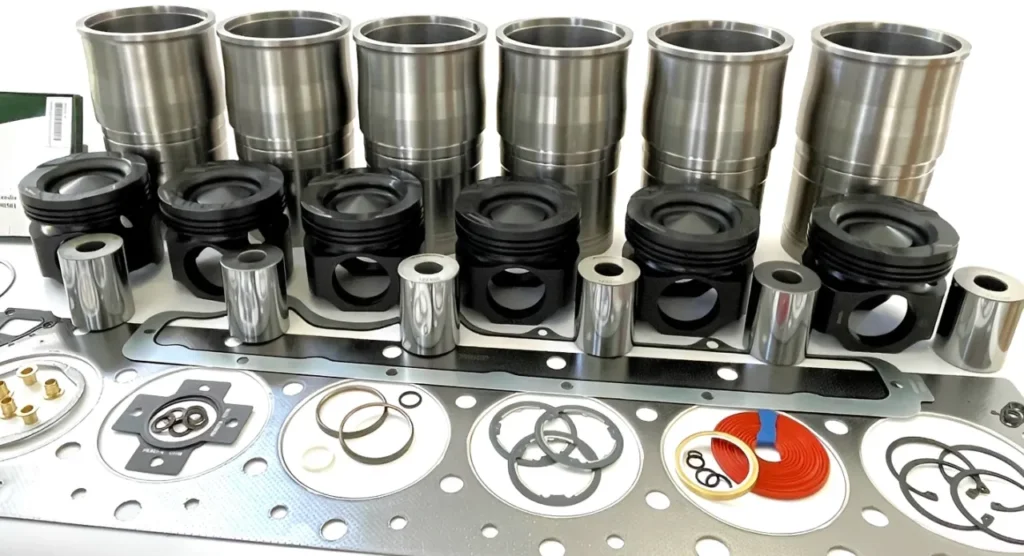
| 4352581 | Upper Engine Gasket Kit | Cummins ISX15 / QSX15 | Material: MLS (Multi-Layer Steel) + FKM Coating Cylinder Diameter: 137mm Application: Heavy-Duty Highway / Road Trains MOQ: 1 Set Customized Service: Accepted (OEM/ODM) | Global / North America / Australia |
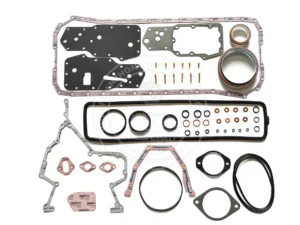
| 4352582 | Lower Block Gasket Kit | Cummins ISX15 / X15 | Material: High-Temperature FKM / Silicone Application: Commercial Truck Bottom-End MOQ: 1 Set Customized Service: Accepted (OEM/ODM) | Global / North America / Australia |
The ISX15 is the premier engine choice for North America's largest commercial truck brands. Our sealing products are fully compatible with vehicles relying on this massive powerplant, including the Peterbilt 389, Kenworth W900, Freightliner Cascadia, and International ProStar.
Related Products
Contact Us
Even with the correct Cummins ISX15 torque specs in your hands, achieving a successful, leak-free rebuild requires far more than just tightening bolts. You need components that can withstand 200+ bars of cylinder pressure and massive thermal expansion.
When you use inferior, cheap aftermarket gaskets, they crush unevenly, causing your perfectly torqued cylinder head to lose its clamping force. At VP GASKET, we manufacture industry-leading Multi-Layer Steel (MLS) cylinder head gaskets, extreme-temperature FKM oil pan seals, and complete, ready-to-install overhaul kits specifically designed for the massive Cummins ISX15 and X15 platforms.
Our Exclusive Product Advantages Include:
- ISO-Certified Precision: Every gasket is manufactured to exact OEM dimensional tolerances to guarantee a perfect fit during your rebuild.
- Premium MLS Technology: Our multi-layer steel head gaskets feature specialized recovery layers that act like microscopic springs, maintaining a perfect seal.
- Chemical Immunity: We utilize high-grade FKM coatings that completely resist degradation from highly acidic synthetic diesel oils.
If you are preparing for a major engine overhaul and need reliable, OEM-grade sealing parts to match your precise ISX15 head bolt torque sequence efforts, we are ready to assist you.
FAQ
What are the most important Cummins ISX15 torque specs I need to know?
The absolute most critical torque specifications involve the cylinder head bolts, the main bearing caps, and the connecting rod bolts. These specific components experience the highest physical stress loads and rotational forces inside the engine block.
Can I safely reuse my old ISX15 head bolts during a rebuild?
No, never. ISX15 head bolts are torque-to-yield (TTY) fasteners. Once they are stretched to their final 90-degree angle specification, they permanently lose their elasticity. Reusing them will result in snapped bolts or a blown head gasket.
Why is following the exact ISX15 head bolt torque sequence so important?
Following the strict center-outward torque sequence prevents the massive cast-iron cylinder head from warping. It ensures that the clamping pressure pushes the gasket flat evenly across the engine block, preventing coolant and compression leaks.
What causes the majority of ISX15 engine rebuild failures?
The most common causes of premature failure are improper torque procedures (especially skipping the final angle rotation), incorrect bearing clearances, reusing fatigued TTY fasteners, and poor cleaning of the engine block deck surface.
Do all Cummins ISX15 engines use the same torque specs?
No. While many fundamental procedures are similar, torque specifications and fastener designs can vary slightly between the CM870, CM2250, CM2350, and modern X15 Performance or Efficiency Series engines. You must always verify the exact specs using your specific Engine Serial Number (ESN).