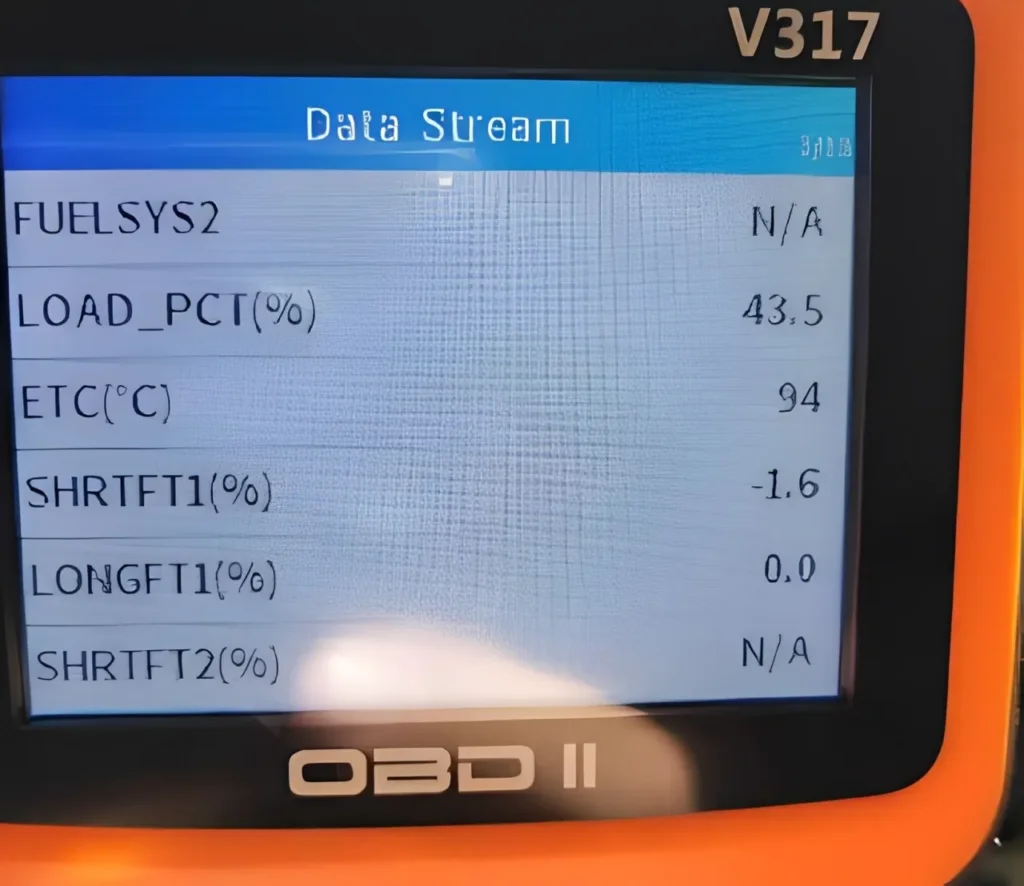
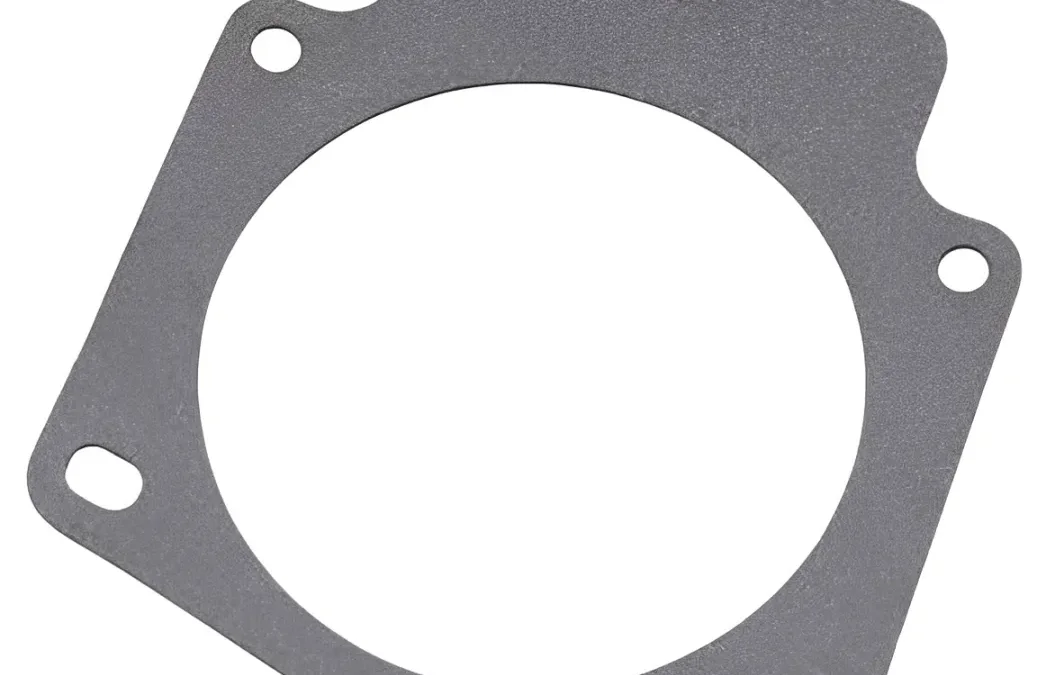
A repair shop cleaned a customer’s throttle body to cure a sticky idle. Ten minutes after reassembly, the engine surged, set a lean-airflow code, and nearly stalled at the first junction. The old seal had been reused, but the electronic throttle had also lost its learned airflow reference. Those two problems can feel almost identical. This guide explains throttle body gasket symptoms after cleaning, then gives workshops and parts suppliers a safe sequence for separating an intake leak from a relearn issue before another part is ordered.
Estimated reading time: 9–11 minutes.
Table of Contents
Why Throttle Body Gasket Symptoms After Cleaning Appear
Removing the throttle body disturbs a joint that may have remained compressed for years. A paper, fiber, elastomer, or molded seal can take a permanent set, adhere to one flange, tear during removal, or fail to recover when tightened again. Cleaning can also expose corrosion, old sealant, or a scratch that was previously hidden. If the gasket shifts while bolts are started, unmetered air can enter downstream of the airflow measurement strategy.
At the same time, cleaning changes the relationship between throttle angle and airflow. Carbon that previously restricted the opening is gone. On applications that store learned throttle or idle-air values, the control module may initially command the wrong position. Manufacturer bulletins from GM and Honda document rough or unstable idle and related codes after throttle-body cleaning when the required reset or idle learn is not completed. That means throttle body gasket symptoms after cleaning cannot be diagnosed from idle quality alone.
Before following this post-cleaning diagnostic path, see our earlier overview, Throttle Body Gasket Replacement and Symptoms: Maximizing Engine Airflow. The earlier article explains the general seal and airflow relationship; this article concentrates on the harder question of a reused gasket versus a missing relearn immediately after cleaning.
| What changed during service? | Possible result | Evidence to seek |
|---|---|---|
| Old gasket reused | Unmetered air at flange | Tear, imprint, hardening, displaced edge |
| Carbon removed | Stored airflow value no longer matches | Symptoms begin after cleaning; relearn not performed |
| Connector or hose disturbed | Sensor, purge, PCV, or vacuum fault | Loose connector, split elbow, disconnected hose |
| Cleaner entered component | Temporary or permanent electrical/mechanical issue | Product/application mismatch or directed spray into electronics |
| Bolts tightened unevenly | Flange distortion or incomplete compression | Incorrect sequence or application-specific torque |
When a broader engine system is being diagnosed, remember that airflow, fueling, sensors, and mechanical sealing interact. Use the application’s service data; a throttle procedure from one engine family must not be copied to another.
Throttle Body Gasket Symptoms After Cleaning at a Glance
The strongest clue is timing: the complaint started immediately after the throttle body was removed, cleaned, or refitted. Still, timing shows association, not cause. Record the pre-service complaint, every disconnected item, scan data before clearing codes, ambient temperature, and whether symptoms occur cold, hot, at idle, or under load.
| Observed symptom | Possible gasket mechanism | Other causes to rule out |
|---|---|---|
| High or surging idle | Unmetered air bypasses normal throttle control | Required relearn, disconnected hose, throttle plate issue |
| Lean codes or positive fuel trim | Control system adds fuel to offset extra air | MAF contamination, exhaust leak, weak fuel delivery |
| Stall at stops | Airflow changes outside expected idle control | Relearn, charging voltage, ignition, fuel fault |
| Hissing near flange | Air passes through a narrow gap | Split hose, intake crack, brake-booster or purge line |
| Poor response or reduced power | Airflow plausibility fault may limit operation | Connector, actuator, pedal, wiring, boost leak |
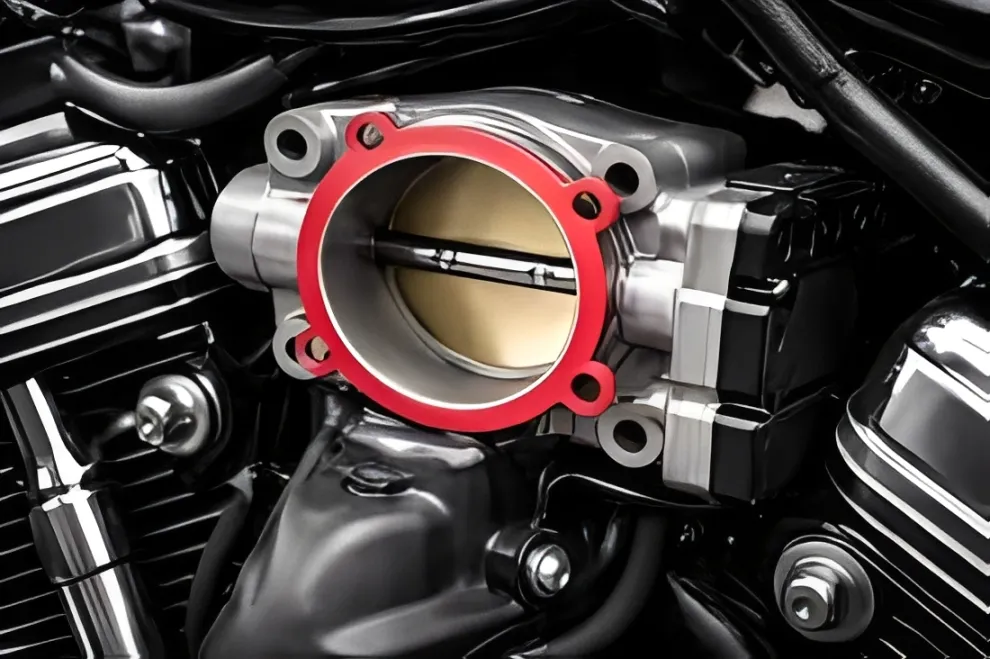
Throttle Body Gasket Symptoms After Cleaning: Leak or Relearn?
A relearn problem and a gasket leak can coexist. Perform the manufacturer’s specified throttle or idle learn when the procedure requires it, but do not use repeated resets to hide a physical air leak. Likewise, do not replace the gasket solely because an idle learn temporarily improves the symptom.
| Pattern | More consistent with gasket leak | More consistent with relearn issue |
|---|---|---|
| Physical inspection | Damaged, missing, hardened, or displaced seal | Joint intact; no leak evidence |
| Smoke test | Smoke appears at flange under approved low pressure | No external smoke found |
| Fuel trim | Positive at idle and often improves as airflow rises | Pattern depends on application and learned value |
| Correct relearn | Leak evidence or symptoms remain | Idle stabilizes and codes do not return |
| Timing | Starts after seal was disturbed | Starts after cleaning or battery/control reset |
“I treat throttle body gasket symptoms after cleaning as two parallel questions: can I prove an air path, and has the exact relearn procedure been completed? Answering only one invites a comeback.”
Ethan Brooks
Driveability Diagnostic Specialist
A diagnostic trouble code does not identify the failed part. GM service information, for example, links incorrect learned throttle values with rough or unstable idle and P1101 on specified applications; a Honda bulletin links post-cleaning idle fluctuation and P2279/P0507 with a required learn procedure on specified vehicles. These are examples of why model-specific instructions matter, not universal rules for every engine assembly.
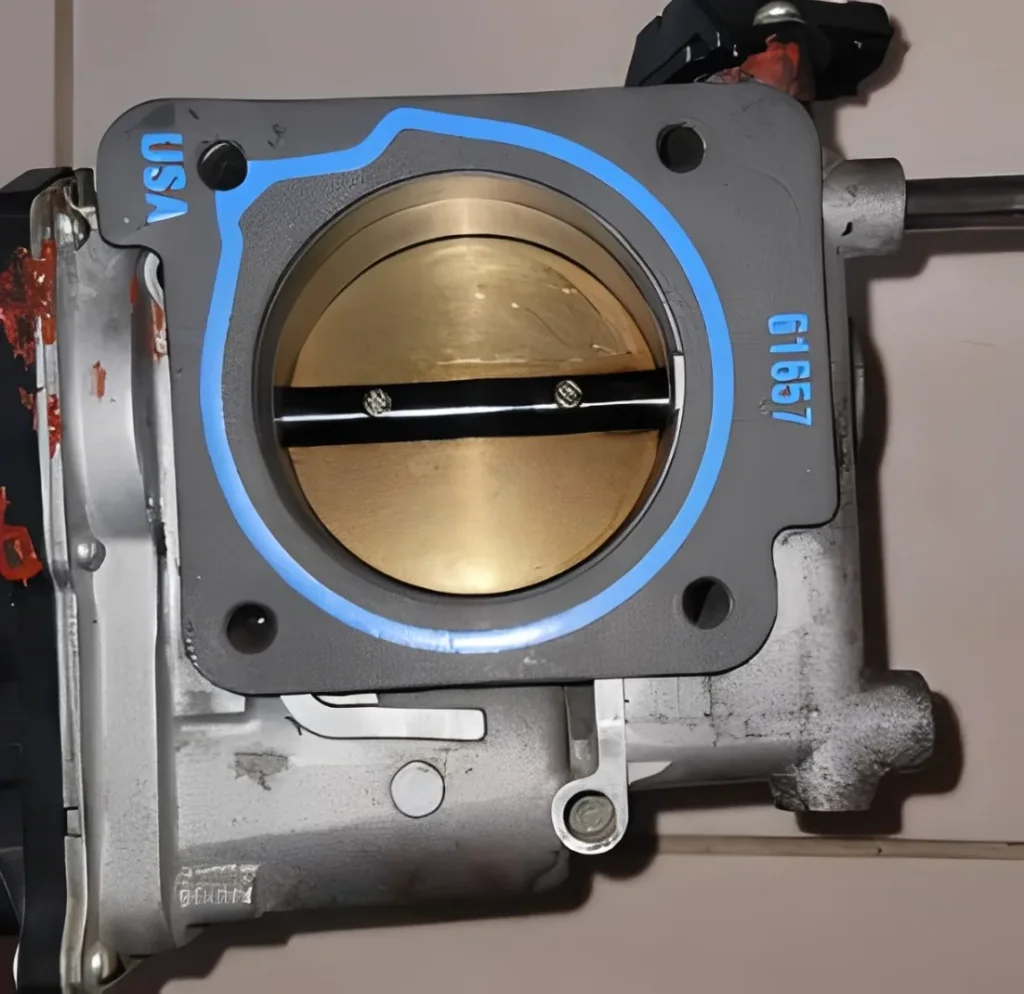
How to Inspect Throttle Body Gasket Symptoms After Cleaning
Begin with the engine off and cool. Confirm that the intake duct, clamps, electrical connector, purge line, PCV line, brake-booster hose, and any removed brackets are correctly installed. Check that no shop towel or plug remains in the inlet. Photograph the assembly before moving anything.
Throttle Body Gasket Symptoms After Cleaning: Visual Joint Check
Look for a visible gasket edge around the joint, a pinched corner, a gap between flanges, or debris trapped under the body. Uneven witness marks on the removed gasket may show incomplete compression. Check the throttle body and intake flange for cracks, corrosion, raised residue, and distortion. Follow application-specific flatness and surface-finish limits; do not sand a precision or coated surface casually.
Throttle Body Gasket Symptoms After Cleaning: Low-Pressure Smoke Test
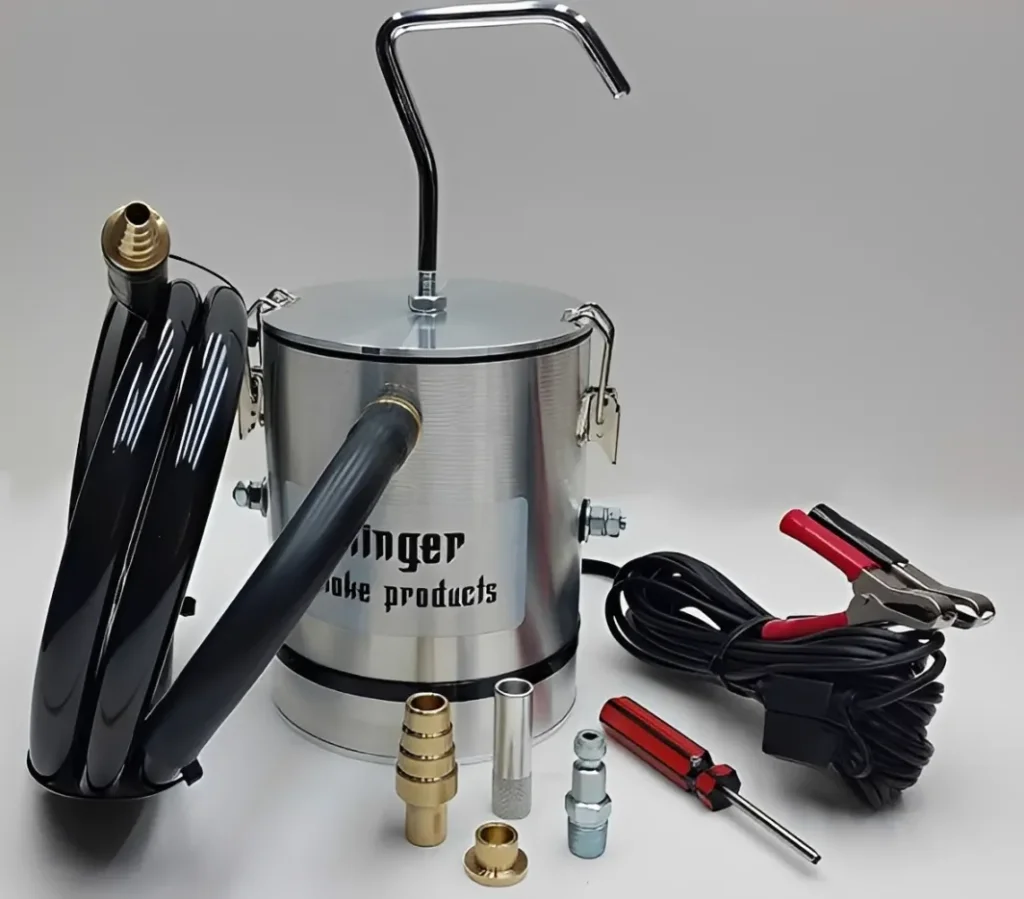
A regulated automotive smoke machine can help locate a small intake leak when used by the machine and vehicle manufacturer’s procedure. Seal the system only as directed, use very low regulated pressure, observe the throttle-body perimeter and disturbed hoses, and provide ventilation. Smoke at the gasket flange is direct evidence; no smoke does not prove every operating-condition leak is absent.
Safety note: Never pressurize an intake with unregulated shop air, never spray flammable cleaner around a running engine to hunt for a leak, and keep hands, clothing, and tools away from an electronically commanded throttle plate. Some electronic throttles can move without a person touching the pedal.
| Test | What it can show | Important limitation |
|---|---|---|
| Visual inspection | Misassembly, damage, loose connection | Cannot expose every small leak |
| Regulated smoke | Location of an external air path | Pressure and sealing method must be approved |
| Fuel-trim comparison | Idle-sensitive unmetered-air pattern | Fuel, sensor, and exhaust faults can imitate it |
| Manufacturer relearn | Whether learned airflow was the problem | Does not repair a physical leak |
| Reinspection after heat cycle | Temperature-dependent change | Do not retorque unless specified |
Throttle Body Gasket Symptoms After Cleaning: Diagnostic Sequence
- Verify exactly what was removed, cleaned, disconnected, and reused.
- Scan all modules and save codes, freeze-frame data, throttle position, airflow, and fuel trims before clearing anything.
- Inspect the intake duct, hoses, connectors, flange, gasket edge, and fasteners with the engine off.
- Confirm that the cleaning method and product were approved for the application.
- Perform the exact manufacturer throttle/idle relearn when required.
- If symptoms remain, use approved low-pressure smoke and fuel-trim testing to prove or reject an air leak.
- Replace the gasket when it was specified as single-use, is damaged or compressed, or a flange leak is confirmed; repair damaged surfaces or hoses at the same time.
- Clear codes only after recording them, conduct a controlled verification drive, and recheck for pending codes.
Interactive Leak-or-Relearn Triage
Select the observed evidence. The result suggests the next check, not a final diagnosis.
“A new gasket and the correct idle learn solved our comeback. The important lesson was documenting both repairs separately so we knew the air leak was gone and the control module had adapted.”
Laura Mitchell
Independent Repair Shop Owner
When Throttle Body Gasket Symptoms After Cleaning Need a New Seal
Replace the gasket when service information indicates it is single-use, when it tears or separates during removal, when it has hardened or taken a deep, permanent set, when its sealing bead is damaged, when it no longer remains in place, or when testing confirms a leak at the flange. One GM service procedure explicitly instructs technicians to install a new throttle-body gasket on the listed application, illustrating why local service data takes priority.
For a supplier, the correct request includes VIN or equipment identification, engine code or serial number, throttle-body number, removed-gasket dimensions and photographs, and market/emissions configuration. VPGASKET supplies gasket repair kits and seals. Our wider engine gasket set, Cummins engine gasket, Cummins B Series gasket kit, upper engine gasket kit, and lower gasket kit pages show the level of application detail expected for gasket sourcing; they are not a claim that a complete engine kit is required for a throttle-body repair.
| Ordering field | Why it matters | Evidence |
|---|---|---|
| VIN/equipment and market | Emissions and intake versions can differ | Registration or build record |
| Engine code/serial number | Identifies production configuration | Identification plate photo |
| Throttle-body number | Confirms flange and bolt pattern | Legible component label |
| Removed gasket | Reveals shape, ports, thickness, damage | Top and bottom photos with scale |
| Diagnostic result | Prevents ordering for a relearn-only issue | Smoke result, codes, fuel trims, relearn status |
Do not replace a full overhaul kit to address an isolated throttle-body seal. For unfamiliar diesel platforms, use an application guide for engine sensor symptoms only as general diagnostic context, then return to the vehicle maker’s throttle and intake procedure.
Relevant YouTube video: Smoke testing and fuel-trim diagnosis for an intake vacuum leak. Treat the video as a technique overview and follow the pressure and connection limits for the vehicle and test equipment in your shop.
Throttle Body Gasket Symptoms After Cleaning FAQs
Can an Old Gasket Be Reused After Throttle Body Cleaning?
Only if the manufacturer permits reuse and the seal is undamaged, dimensionally stable, clean, and correctly located. If service information specifies a new gasket, replace it. The low price of a seal does not justify ignoring an application rule.
Do Throttle Body Gasket Symptoms After Cleaning Always Mean a Relearn?
No. A relearn may be required, but a displaced gasket, loose hose, connector problem, damaged flange, or inappropriate cleaning method can create the same timing. Inspect the work and prove the leak path.
Will a Throttle Body Gasket Leak Disappear When Warm?
A small gap may change as parts expand, and fuel-control corrections may mask symptoms, but disappearance does not confirm repair. Compare cold and hot data and retest using the approved method.
Which Codes Prove the Throttle Body Gasket Is Leaking?
No code proves the gasket itself failed. Lean, idle-speed, airflow, and throttle codes indicate a system condition. Use freeze-frame data, inspection, relearn status, fuel trims, and a controlled leak test.
What Information Should a Parts Supplier Request?
Request VIN or equipment identity, engine code/serial number, throttle-body part number, market, photographs and measurements of the removed gasket, flange condition, codes, and confirmation of the required relearn. This prevents a symptom description from becoming an inaccurate part match.
Conclusion: The practical way to resolve throttle body gasket symptoms after cleaning is to test two hypotheses in parallel. Verify that the seal and every disturbed connection are airtight, then complete the exact manufacturer relearn when required. A recorded sequence protects the customer from unnecessary parts, helps the workshop avoid a return, and provides VPGASKET with sufficient application evidence to identify the correct seal when replacement is justified.