
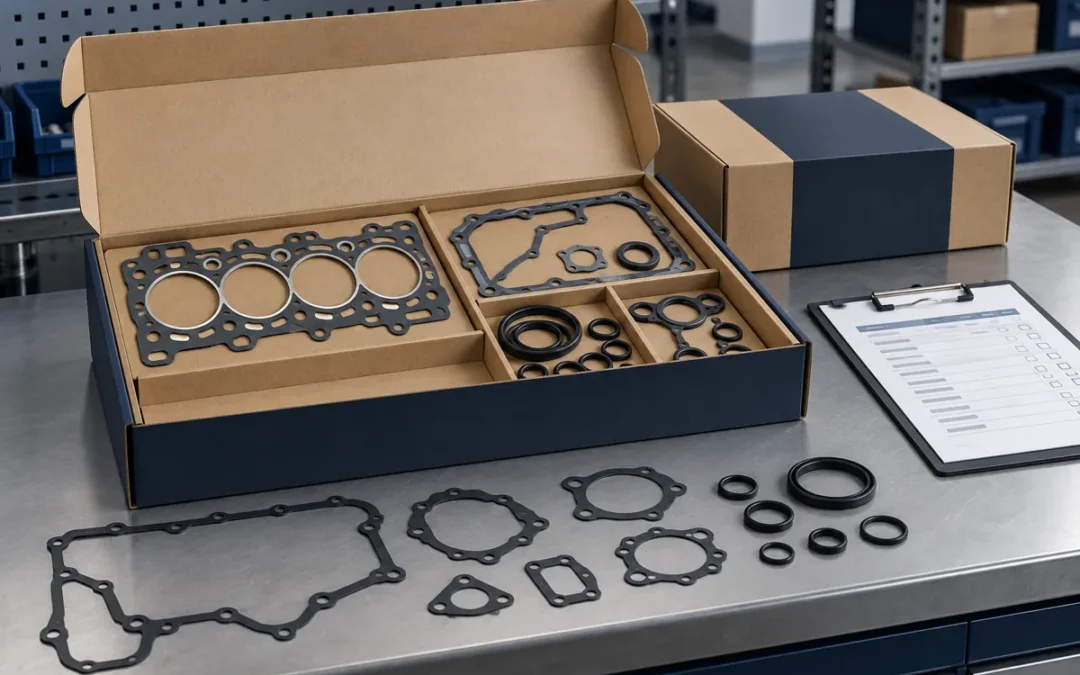
A regional diesel-parts distributor is ready to launch private label engine gasket kits. The logo is approved and the sales team wants stock immediately, but the first packaging proof reveals three problems: two applications share a similar product name, the carton has no controlled revision, and the component list does not match the buyer's catalog. A private-label launch can fail before the first sale if identity, kit contents and change control are treated as artwork tasks. This guide explains eight requirements that turn a branded box into a repeatable B2B product.
Estimated reading time: 9-11 minutes.
Table of Contents
Why Private Label Engine Gasket Kits Need a Controlled Launch Brief
Private labeling changes more than the outside of a carton. The buyer becomes responsible for how the product is identified in its own catalog, warehouse and market. The supplier still has to build and pack the agreed product, but both sides need one approved record linking the kit reference, application evidence, component list, artwork and packaging specification.
Before developing a branded range, review Cummins Gasket Kit Supplier: 9 Critical Approval Checks. Supplier capability should be approved before branded inventory makes a quality or fitment problem more expensive to correct.
| Launch question | Controlled evidence | Risk if missing |
|---|---|---|
| What is the product? | Buyer SKU, supplier reference and dated packing list | Similar kits are confused |
| What does it fit? | Application source and verification status | Returns and disputed fitment |
| How is it presented? | Approved artwork and packaging specification | Inconsistent brand presentation |
| How is it revised? | Revision code, approval date and change notice rule | Old and new versions mix |
| How is it accepted? | Sample, inspection and receiving criteria | Approval becomes subjective |
8 Critical Private Label Engine Gasket Kits Requirements
1. Define the Private Label Engine Gasket Kits Market Before Artwork
Start with the customer and repair scope, not the box design. Record the engine families, target applications, upper or lower set boundary, expected order mix and language requirements. For private label engine gasket kits, the same brand may eventually cover several kit types, so the naming system must remain clear as the range grows.
| Scope field | Example decision | Approval owner |
|---|---|---|
| Sales channel | Distributor counter, workshop network or online catalog | Commercial team |
| Repair boundary | Upper, lower or complete sealing scope | Technical buyer |
| Application identity | Engine model, reference and ESN/CPL evidence where available | Application reviewer |
| Pack quantity | One kit per unit carton | Warehouse and purchasing |
| Language set | Market-required product and handling text | Brand owner |
2. Build a Buyer-Supplier SKU Map
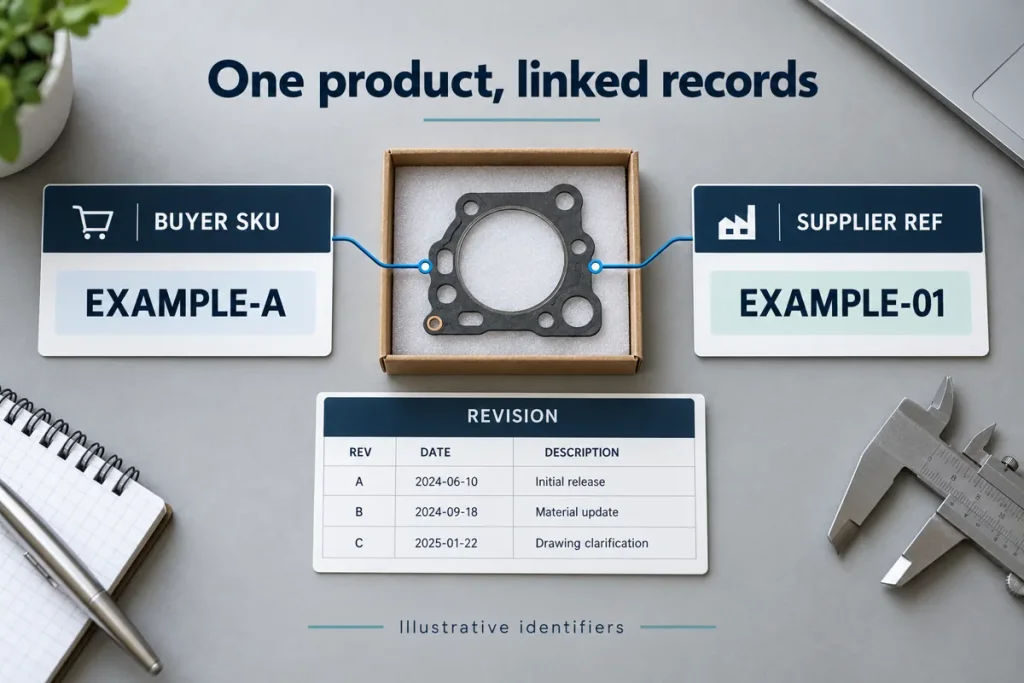
Give every approved item a buyer SKU and connect it to the supplier's controlled reference. Add the engine family, kit type, packing-list revision and artwork revision. Do not use a marketing description as the only identifier. When an old kit, sample or reference number is supplied, preserve its source and verification status instead of silently treating it as confirmed interchangeability.
3. Freeze the Private Label Engine Gasket Kits Packing List
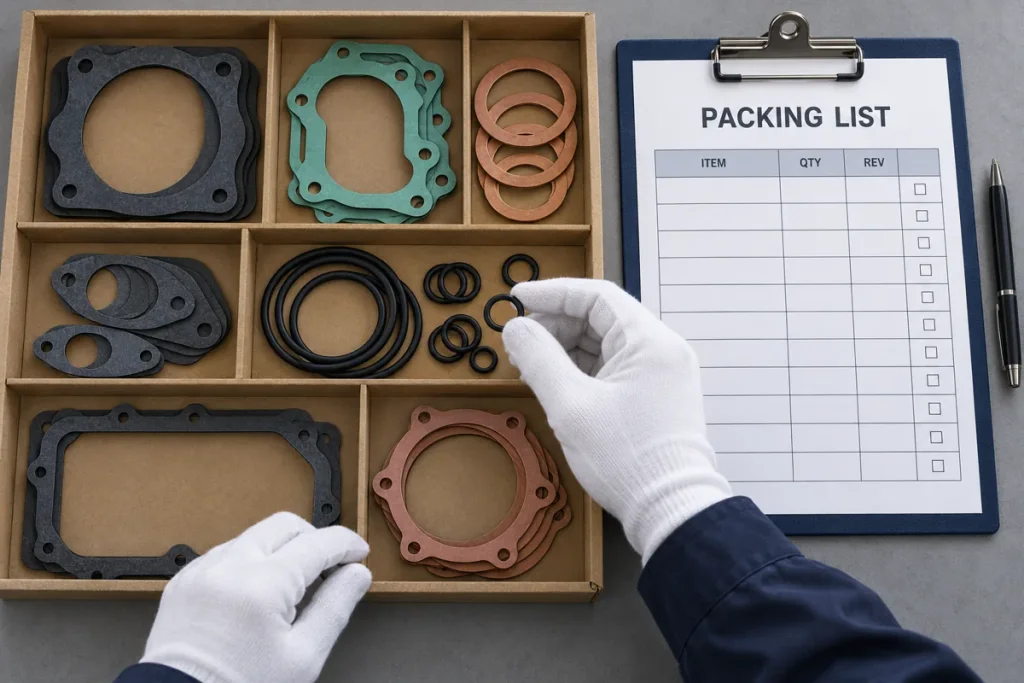
The packing list is the product definition behind private label engine gasket kits. It should state the component description, quantity and revision. Layout photographs help receiving teams, but photographs cannot replace a dated list. Ask how substitutions, deleted parts and material changes are reviewed before a new production batch.
| Packing-list control | Minimum entry | Receiving use |
|---|---|---|
| Kit identity | Buyer SKU and supplier reference | Matches order and carton |
| Component identity | Description or controlled component number | Separates similar seals |
| Quantity | Count per finished kit | Finds shortages |
| Revision | Version and approval date | Prevents mixed definitions |
| Exclusions | Items deliberately outside the approved kit | Prevents assumed contents |
4. Approve Label Data, Barcodes and Trace Codes
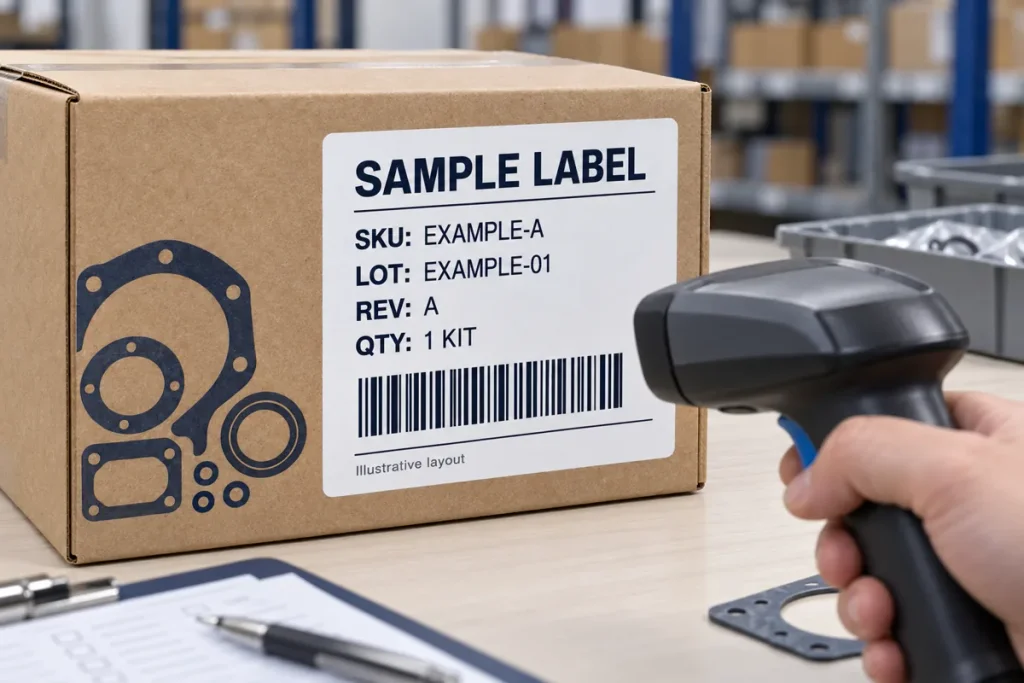
A label should help the warehouse identify the item without opening it. Typical fields include the buyer SKU, product description, quantity, revision or lot code and country-of-origin information where required. If a barcode is used, define who owns the identifier and verify that it scans in the buyer's system. GS1 explains that GTINs identify trade items; the brand owner should decide whether and how that standard fits its catalog and market.
5. Set Measurable Packaging for Private Label Engine Gasket Kits
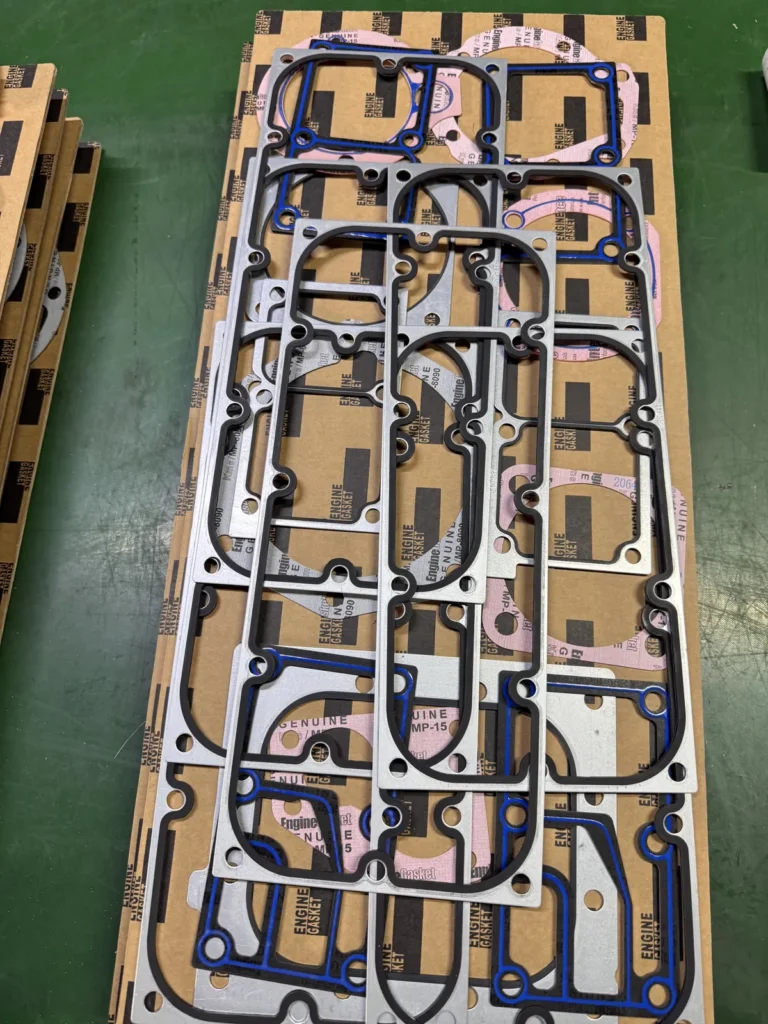
Define carton dimensions, board or container type, internal protection, label location, closure method and master-carton quantity. Thin metal parts need flatness protection; small seals need controlled separation; coated surfaces should not rub during transit. Cummins publishes supplier packaging information that demonstrates why packaging and label requirements are purchasing data, not decoration.
6. Control Artwork Files and Legal Review
Store the approved artwork as a controlled file with a revision and approval date. Separate verified product facts from promotional language. The brand owner should review trademarks, required origin statements, local-language rules and any market-specific claims before printing. Neither a supplier nor a printer should improvise claims or application coverage to fill empty space.
| Artwork element | Control question | Evidence before release |
|---|---|---|
| Brand and logo | Is the correct master file used? | Brand-owner approval |
| Product name | Does it match the SKU map? | Catalog comparison |
| Application text | Has fitment been verified? | Application-review record |
| Barcode | Does it scan to the intended SKU? | Scan test |
| Revision mark | Can old and new packaging be separated? | Artwork history |
7. Approve a Complete Private Label Engine Gasket Kits Sample
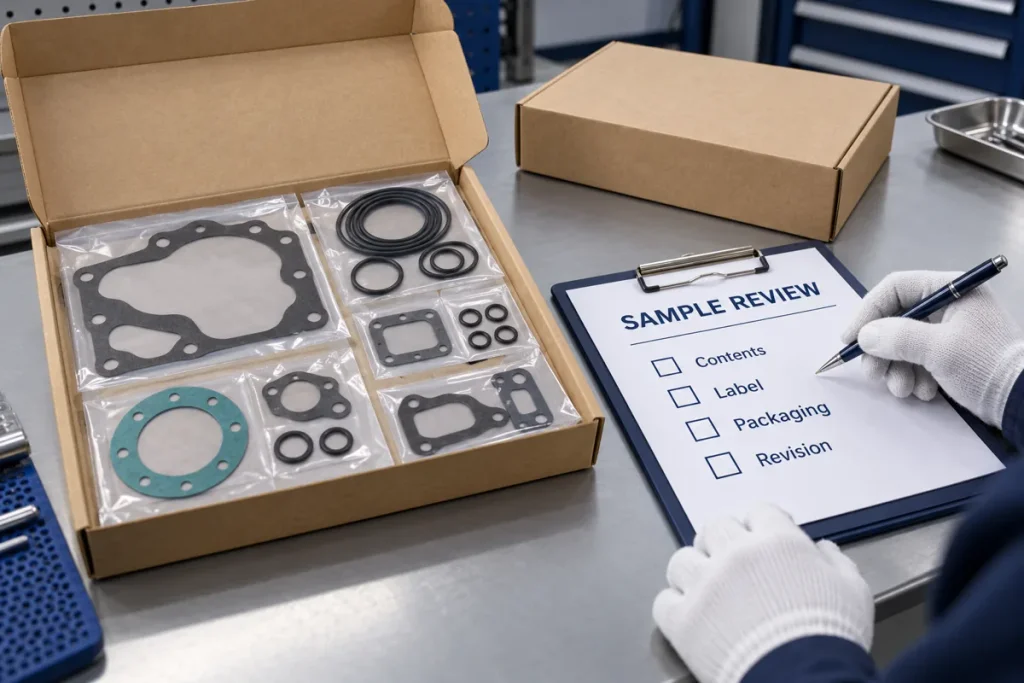
Approve a finished sample that includes the actual kit contents, retail packaging, label and master-carton presentation. Record any approved deviations. A digital artwork proof cannot show carton strength, print alignment, component arrangement or whether the label remains readable after handling. Keep one buyer sample and one supplier sample linked to the same approval record.
“Our brand launch became manageable when we stopped approving the carton and the product in separate email threads. One signed sample linked the SKU, packing list, barcode and artwork, so receiving inspection had a clear reference.”
Illustrative distributor scenario
Daniel Foster, Product Line Manager
8. Agree on Reorders and Change Notification
A successful first order does not control the second. The purchase agreement should identify changes that require notice, including packing-list revisions, material or source changes, artwork updates, manufacturing-location changes and packaging substitutions. State how remaining old-version stock will be handled. This protects both the distributor's catalog and the supplier's production plan.
Interactive Private Label Engine Gasket Kits Launch Gate
Use this launch gate before releasing printed packaging or a bulk purchase order. It organizes missing approvals; it does not replace application verification or market-specific legal review.
Private Label Launch Readiness
Select every item supported by an approved current record:
| Launch gate | Pass condition | Hold condition |
|---|---|---|
| Product | Application and packing list approved | Fitment or contents still assumed |
| Identity | SKU, barcode and trace code agree | Similar kits cannot be separated |
| Packaging | Finished pack passes handling review | Only a digital artwork proof exists |
| Order | MOQ, lead time and version are written | Commercial assumptions remain verbal |
| Reorder | Change notification and old-stock plan agreed | Supplier may substitute without review |
How to Request Private Label Engine Gasket Kits From VPGASKET
Prepare a spreadsheet containing the target reference, engine application, kit type, annual or initial quantity, packaging format, label data and destination. Buyers can review the VPGASKET home page, browse the engine gasket product range, check the Cummins B Series range, learn about the company background, and send the controlled request through the contact page.
For product and factory video context, visit the VPGASKET YouTube channel. Confirm final private label engine gasket kits requirements in the written quotation, packing list and approved sample rather than relying on video alone.
Private Label Engine Gasket Kits FAQs
What determines the MOQ?
MOQ can depend on the kit reference, printed packaging, label method, component availability and whether several SKUs share the same production or packaging setup. Request the MOQ per SKU and for the total mixed order.
Should the buyer approve an unbranded sample first?
It can be useful to approve contents and application evidence before spending on printed packaging. Final approval should still include a complete branded sample.
Who should provide the barcode?
The brand owner should control identifiers used in its catalog and market. Agree on the data source, format, placement and scan test before printing.
Why can private-label lead time differ from a neutral order?
Artwork approval, printed-material preparation, sample review and SKU-specific packing add milestones. Ask for separate dates for technical confirmation, artwork, sample approval, production and shipment readiness.
Should the quotation include an Incoterms rule?
Yes. State the selected rule and named place so transport obligations, cost boundaries and risk transfer can be compared. The ICC's Incoterms 2020 resources explain the role of those rules.
Final Private Label Launch Decision
Successful private label engine gasket kits are controlled products, not generic kits placed in a branded carton. Define the market and repair scope, map both SKU systems, freeze the packing list, test identifiers, specify packaging, control artwork, approve a finished sample and agree on future changes. Those eight requirements give purchasing, warehouse and sales teams the same product definition—and make a repeat order easier to execute than the first.