

Description
Stop Bleeding Turbo Boost: The Ultimate 4089201 QSK60 Aftercooler Quadrant Shield
Product Specifications
| Specification | Details |
| Product Name | Aftercooler Quadrant Gasket Kit / Charge Air Cooler Seal Set |
| OEM Part Number | 4089201 |
| Engine Compatibility | Cummins QSK60 (V16 Quantum Series) |
| Brand | VPGASKET |
| Material Construction | High-Temp Silicone, Premium Viton (FKM), Reinforced Composites |
| Application | Ultra-Class Haul Trucks, Marine Propulsion, Prime Power Gen |
| Condition | 100% Brand New Premium Aftermarket Replacement |
Why Your 60-Liter Titan Needs Precision Quadrant Sealing
The Cummins QSK60 is an industrial behemoth that lives and breathes on massive amounts of compressed air. Due to the extreme length of the 60-liter V16 block, the intake and aftercooler (charge air cooler) architecture is segmented into quadrants. If any one of these quadrant circuits develops even a microscopic leak, the entire engine bleeds off the critical boost pressure required to generate maximum torque. This results in sluggish response, dangerously high exhaust gas temperatures (EGTs), and wasted fuel. The 4089201 aftercooler quadrant gasket kit is the professional’s choice for restoring factory-new air density across the entire manifold. Engineered to handle extreme thermal cycling, this kit ensures your V16 stays oxygen-rich and fully pressurized under 100% load.
Erase Costly QSK60 Downtime with High-Temp Sealing Technology
In the high-stakes world of maritime shipping or deep-pit mining, an inefficient intake system is a massive financial drain. A compromised quadrant seal forces your massive turbochargers to work harder, shortening their lifespan and exponentially increasing your total cost of ownership. By upgrading to the high-performance 4089201 package from VPGASKET, you lock in maximum equipment availability. We utilize premium high-temperature composites that refuse to shrink, harden, or crack under the brutal heat gradients of industrial turbocharging, keeping your fleet operational in the most punishing environments on Earth.
Inside the 4089201 Kit: The Arsenal to Rebuild Your V16 Intake
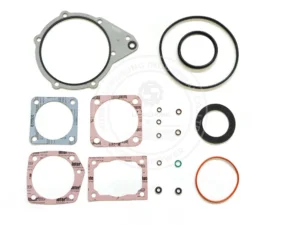
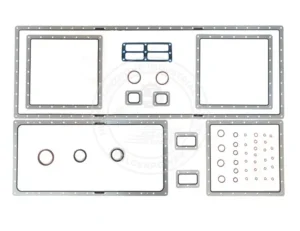
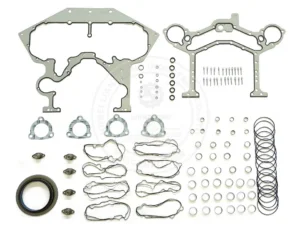
Rebuilding a segmented QSK60 air system requires a flawless, unified sealing strategy for the massive aftercooler architecture. The 4089201 quadrant repair package provides every critical component required for a “first-time-right” overhaul:
-
Precision Quadrant Core Seals: Specifically designed to secure the heavy cooling cores within the segmented housings, absolutely preventing high-pressure air bypass.
-
Thermal-Resistant O-Rings: High-density Viton components that isolate the cooling jacket, preventing catastrophic water-to-air contamination across the quadrants.
-
Vibration-Dampening Gaskets: Formulated to absorb the violent mechanical frequencies of a V16 rotating assembly without losing the critical sealing bead.
-
Intake Manifold Connectors: Robust, high-temp seals that maintain boost integrity even during the extreme heat of 24/7 industrial duty cycles.
Pro-Level Installation Standards to Prevent Boost Blowouts
To guarantee that the 4089201 aftercooler seals provide a permanent barrier against leaks, your maintenance team must strictly follow these industrial protocols:
-
Surgical Surface Preparation: The aluminum quadrant housings and core mating surfaces must be surgically clean. Any residual carbon or old sealant will create a microscopic leak path that destroys boost pressure.
-
The Dry Installation Mandate: These advanced air-system seals are engineered for dry assembly. Avoid using RTV silicone or “tack” sprays, which can migrate into the cooling passages and cause localized overheating or turbocharger contamination.
-
Quadrant Pressure Testing: While the unit is disassembled, always pressure test each individual aftercooler core. New gaskets cannot fix a cracked core, and finding a leak now saves you a massive second teardown later.
-
Uniform Clamping Force: Tighten all housing bolts evenly according to the factory torque specifications. Rushing this step on a segmented V16 manifold is the primary cause of “pinched” O-rings and premature gasket failure.

Reviews
There are no reviews yet.